
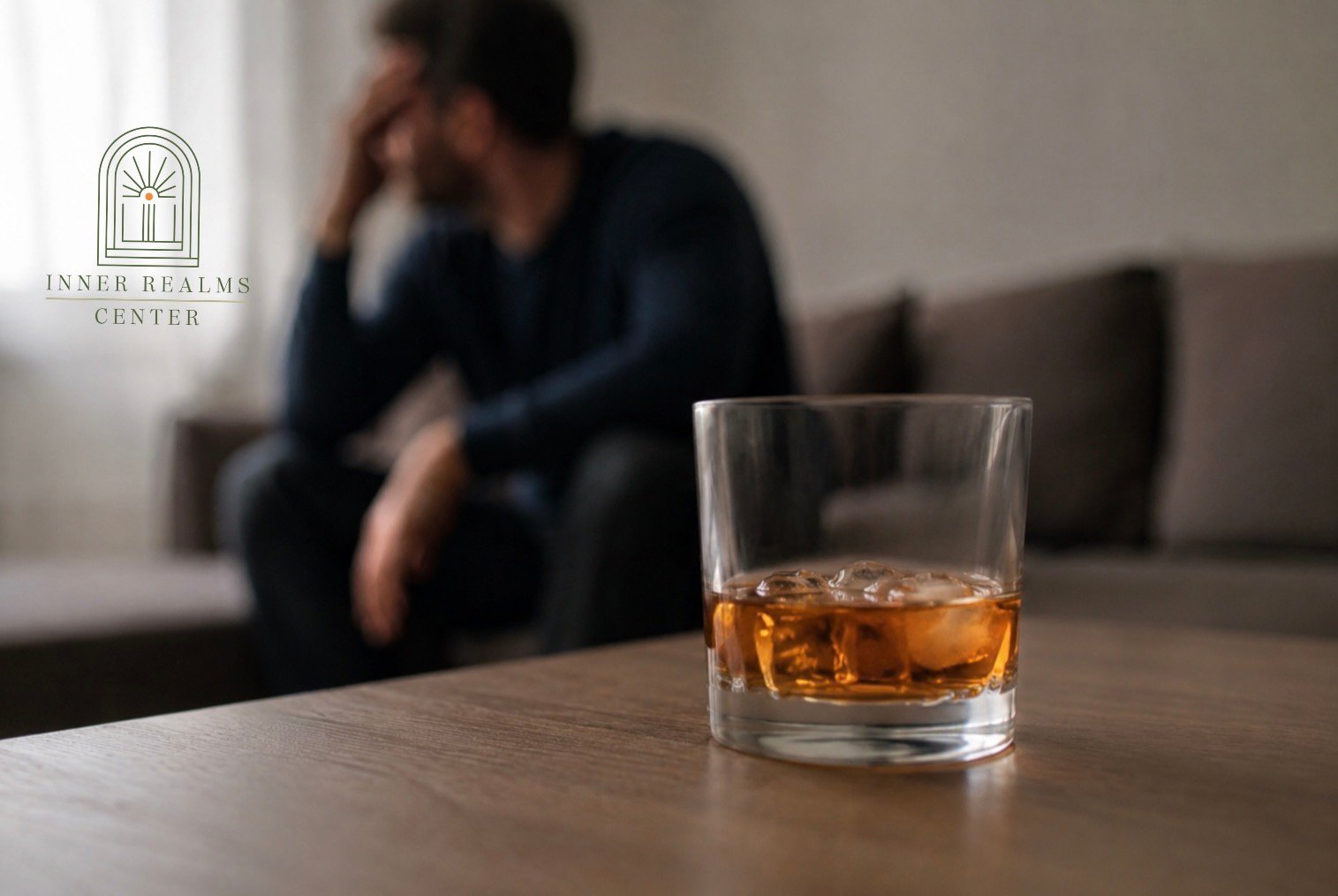
Brad Pitt, Alcohol & Recovery: When “Just One Drink” Matters
What the conversation around Brad Pitt can teach us about addiction, recovery, and the dangerous confidence that can come with time
When “Just One Drink” Becomes a Global Conversation
Over the past several days, headlines around the world have focused on Brad Pitt’s revelation that, after approximately seven years of sobriety, he has returned to drinking alcohol in what he describes as a more restrained manner.
The reactions have been immediate.
Some celebrate the idea that a person can evolve beyond abstinence and eventually learn moderation. Others see the decision as a relapse waiting to happen. Across social media, people are debating whether recovery must mean lifelong abstinence or whether, after enough time and personal growth, someone can safely return to controlled drinking.
At Inner Realms Center, we are not interested in judging Brad Pitt.
We do not know him. We do not know his clinical history, his current relationship with alcohol, the support surrounding him, or the private work he has done over the past seven years.
And one person’s recovery should never be diagnosed through headlines.
But there is another part of this conversation that matters deeply to us.
What happens when millions of people struggling with addiction hear the story of a highly successful, admired person returning to alcohol after years of sobriety and appearing to be fine?
That is where a celebrity story becomes something much more serious.
The Thought That Can Change Everything
People who have lived through addiction often know this thought:
Maybe I’m different now.
I’ve done the work.
My life is stable.
Years have passed.
I’m stronger.
I understand myself better.
Surely one drink cannot take all of that away.
For some people with alcohol use disorder, treatment goals may include reducing consumption rather than complete abstinence. Alcohol use disorder exists on a spectrum, and recovery does not look identical for everyone.
But for people with a history of severe addiction or an established pattern of losing control, the question of returning to a substance cannot be treated casually.
Time in recovery does not automatically erase vulnerability.
The National Institute on Alcohol Abuse and Alcoholism (NIAAA) describes alcohol use disorder as a medical condition that can range from mild to severe. Research also shows that repeated problematic alcohol use can produce changes in brain systems involved in reward, stress, decision-making and behavioral control. Some of these changes can persist after drinking stops and may contribute to vulnerability to a return to problematic drinking.
Recovery and brain healing are possible, and some alcohol-related changes can improve with prolonged abstinence. But recovery does not mean that every person’s previous vulnerability has simply disappeared.
This is something we understand at Inner Realms Center not only professionally, but personally.
Garyth’s Story: When One Drink Wasn’t Just One Drink
Our Clinical Director, Garyth Moxey, knows addiction from both sides of the treatment room.
Long before helping others navigate recovery, he had to navigate his own.
Alcohol was part of that history.
When Time Creates a False Sense of Safety
There was a time, after a significant period of sobriety, when the same seemingly reasonable idea appeared:
Perhaps enough time has passed.
Perhaps things are different now.
Perhaps one drink is possible.
It started with one.
It did not remain one.
Eventually, the old pattern returned.
That experience became part of a much larger understanding of addiction:
Recovery can transform a person’s life without necessarily making the substance that once controlled that life harmless.
Today, Garyth does not approach alcohol from the position that he has somehow defeated it and can therefore safely prove his control over it.
There is nothing left to prove.
For him, protecting what recovery has made possible is worth considerably more than finding out whether he could have one drink.
Addiction Does Not Care How Successful You Are
This is perhaps the most important part of the Brad Pitt conversation.
Celebrity can distort our perception of recovery.
We see someone healthy, productive, successful, wealthy, working, travelling and surrounded by opportunity. If that person drinks again and continues functioning, it becomes tempting to interpret the visible outcome as evidence:
“See? Maybe complete abstinence wasn’t necessary after all.”
But addiction has never been simply a question of intelligence, discipline, social status or success.
At Inner Realms Center, we have met accomplished professionals, parents, entrepreneurs, veterans and people from extraordinarily different backgrounds who arrived at the same painful place.
The substances were different.
Their childhoods were different.
Their traumas were different.
Their circumstances were different.
But beneath the substance itself, we repeatedly encounter familiar human patterns: pain, disconnection, shame, trauma, difficulties regulating emotions, compulsive behavior, attempts to escape internal suffering, and eventually the enormous consequences addiction can create around the individual.
Addiction Affects More Than the Person Using
Addiction rarely affects only the person using the substance.
Partners live through it.
Children live through it.
Parents live through it.
Families reorganize themselves around it.
Trust disappears.
Relationships fracture.
Careers can unravel.
And sometimes people who love the individual spend years trying to rescue someone who cannot yet rescue themselves.
That is why we cannot treat the question of returning to alcohol as an interesting lifestyle experiment.
For some people, the stakes are simply too high.
Recovery Is Not the Same Thing as Being Cured
One of the misconceptions surrounding long-term recovery is the idea that the passing of time should eventually produce immunity.
Ten years without alcohol can represent extraordinary healing.
It can mean ten years of repaired relationships, physical and neurological recovery, accountability, emotional work, stability and learning how to live without needing a substance to change how one feels.
But those ten years do not need to culminate in proving that alcohol can now be consumed.
“The ability to abstain is not evidence that you should test whether you still need to.”
For some people, the greatest sign of recovery is no longer needing to conduct that experiment.
This does not mean living frightened of alcohol.
It means understanding oneself.
There is an important difference between fear and respect.
A Return to Use Is Not a Moral Failure
There is another danger in the current conversation.
We should not turn Brad Pitt, or anyone else who returns to substance use, into an example of failure.
Recovery is rarely a perfectly straight line.
A return to drinking does not erase seven years of sobriety. It does not erase the work accomplished during those years, and it does not make someone weak or fraudulent.
It means something happened that deserves attention.
The Questions That Matter After a Return to Use
For clinicians, families and people in recovery, the useful question is not:
“How could you throw all those years away?”
The useful questions are:
What changed?
What made alcohol seem safe again?
What need is it meeting now?
What support has changed?
What warning signs appeared before the first drink?
And most importantly:
What needs to happen next to protect the life that has been rebuilt?
Shame is not a treatment strategy.
Awareness, accountability, support and appropriate treatment offer a more constructive path forward.
Brad Pitt Is One Man. His Experience Is Not a Treatment Recommendation.
This distinction matters.
Brad Pitt has every right to make decisions about his own life.
But celebrity experiences should not become clinical guidance.
Someone watching from home may know only the headline:
“Seven years sober. Drinking again. Doing fine.”
They do not know what happens when the cameras are gone.
They do not know what happens six months from now.
Neither do we.
And that is precisely the point.
A person who has fought hard to escape a destructive relationship with alcohol should not use someone else’s public story as evidence that returning to alcohol is safe for them.
Recovery is too individual, and the consequences are too significant.
The Question We Would Rather Ask
Perhaps the most important question is not:
“After seven years sober, can I drink again?”
Perhaps it is:
“After everything it took to get my life back, what am I hoping alcohol will give me that is worth putting that life at risk?”
That is a very different conversation.
At Inner Realms Center, we meet people when addiction has often taken far more than they ever imagined they would surrender.
We also have the privilege of seeing what can happen when someone begins rebuilding.
Relationships can heal.
Families can reconnect.
People can rediscover dignity, purpose and the ability to be present in their own lives.
Recovery Is About Building a Life Worth Protecting
Recovery is not merely the absence of a substance.
It is the construction of a life that no longer needs to revolve around one.
And sometimes protecting that life means recognizing a simple truth:
“You do not have to prove that you can have one drink. You only have to decide whether what you have rebuilt is worth protecting.”
References
National Institute on Alcohol Abuse and Alcoholism (NIAAA)
Understanding Alcohol Use Disorder
The Cycle of Alcohol Addiction
Neuroscience: The Brain in Addiction and Recovery
Treatment for Alcohol Problems: Finding and Getting Help
Los Angeles Times
Brad Pitt says he’s drinking again after seven years of sobriety
August 10, 2026.
People
Brad Pitt Reveals He’s No Longer Sober After 7-Year Stretch, Drinks in a “More Restrained Manner” Now
August 2026.
Disclaimer
This article is intended for education and reflection. It should not be interpreted as a clinical assessment of Brad Pitt or any other individual, nor as individual medical advice. Recovery pathways and appropriate treatment goals vary between individuals and should be discussed with qualified healthcare professionals.
Struggling with Addiction or Concerned About Someone You Love?
Inner Realms Center provides individualized, clinically supported treatment for people seeking a different path forward.
Request Your Clinical Assessment