
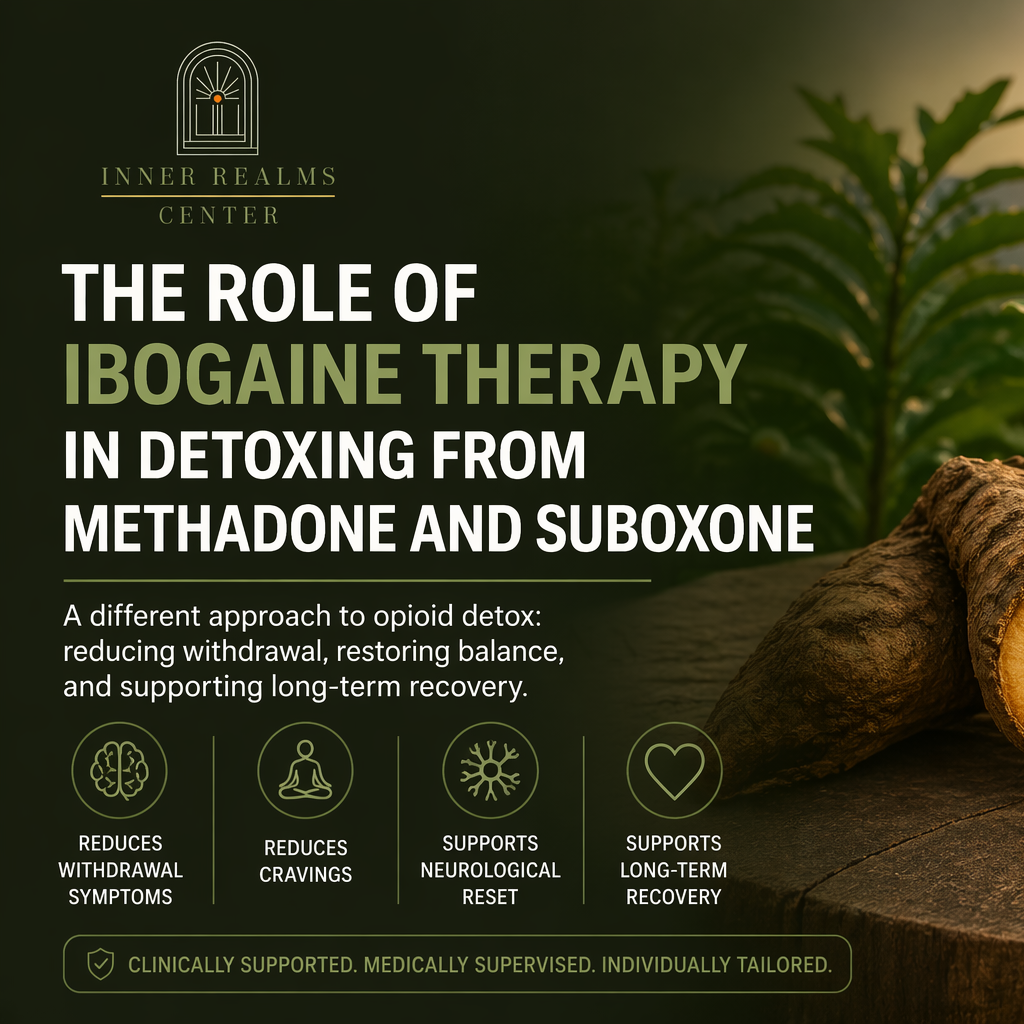
The Role of Ibogaine Therapy in Detoxing from Methadone and Suboxone
Why Methadone and Suboxone Detox Is So Difficult
Methadone and Suboxone (buprenorphine) are commonly used in opioid maintenance therapy. While they can stabilize individuals in the short term, discontinuing them is often one of the most physically and psychologically demanding processes in addiction treatment.
Both substances bind strongly to opioid receptors and have long half-lives. This creates:
- Prolonged withdrawal timelines
- Persistent physical discomfort
- Intense cravings
- High relapse rates during tapering
For many individuals, traditional detox approaches involve gradual dose reductions over months or even years, often with limited success.
Where Ibogaine Fits in the Detox Process
Ibogaine is a naturally occurring psychoactive compound that interacts with multiple systems in the brain, including opioid, dopaminergic, and glutamatergic pathways.
Unlike conventional detox methods, ibogaine does not simply manage symptoms. It appears to act at a neurological level, affecting both withdrawal and craving mechanisms.
Clinical and observational data suggest that ibogaine may:
- Significantly reduce opioid withdrawal symptoms
- Rapidly decrease cravings
- Interrupt patterns of dependence
Some studies report that withdrawal symptoms can be reduced within 24 to 48 hours under controlled conditions
Other observational trials have shown rapid reductions in cravings and withdrawal severity across opioid-dependent populations
Methadone Detox: A Complex Clinical Scenario
Detoxing from methadone requires particular caution.
Methadone accumulates in the body and can:
- Prolong cardiac risk (QT interval changes)
- Interact unpredictably with ibogaine
- Require careful dose reduction before treatment
Emerging research suggests that ibogaine may help reduce methadone tolerance, potentially supporting transition off maintenance therapy
However, this process is not immediate and cannot be approached as a simple substitution.
A structured protocol typically involves:
- Gradual methadone tapering
- Transition planning (sometimes to short-acting opioids)
- Full medical screening before treatment
Without this preparation, the risks increase significantly.
Suboxone Detox: A Different Challenge
Suboxone (buprenorphine) presents a different difficulty.
Because of its high receptor affinity, it can block the effectiveness of ibogaine if not properly cleared from the system.
This means:
- A waiting period is required before treatment
- Withdrawal must begin before ibogaine is administered
- Timing is clinically critical
If managed correctly, ibogaine may still reduce withdrawal severity and help stabilize the transition.
What the Science Currently Shows
The current evidence base for ibogaine remains promising but incomplete.
Key points:
- Multiple observational studies show reductions in withdrawal and cravings
- Some patients report sustained reductions in opioid use and improved psychological outcomes
- Research suggests ibogaine may “reset” neural pathways involved in addiction
At the same time:
- There are no large-scale randomized controlled trials yet
- Outcomes vary depending on medical condition, preparation, and aftercare
- Safety depends heavily on clinical screening and monitoring
This places ibogaine in a category of clinically emerging treatments, not a standardized medical intervention.
Safety: The Most Critical Factor
Ibogaine is not a benign substance.
It carries real medical risks, particularly:
- Cardiac complications
- Electrolyte imbalances
- Drug interactions (especially with methadone and psychiatric medications)
There have been documented serious adverse events in unregulated settings
For this reason, treatment must include:
- Full cardiac screening (ECG, labs)
- Medication review
- Continuous medical monitoring during administration
The context in which ibogaine is given determines the level of safety.
What Ibogaine Does and Does Not Do:
It is important to clarify expectations.
Ibogaine may:
- Interrupt physical dependence
- Reduce acute withdrawal
- Create a neurological and psychological reset
Ibogaine does not:
- Cure addiction
- Replace the need for ongoing support
- Address all behavioral and psychological patterns on its own
Long-term outcomes depend on:
- Preparation before treatment
- Environment during treatment
- Integration and follow-up afterward
A Structured, Clinically Supported Approach
For individuals coming off methadone or Suboxone, ibogaine can only be considered within a structured process.
This includes:
- Individual medical assessment
- Personalized tapering strategy
- Careful timing of treatment
- Continuous clinical supervision
There is no universal protocol. Each case requires adjustment based on:
- Substance history
- Dosage
- Duration of use
- Overall health
Final Perspective
Ibogaine represents a fundamentally different approach to opioid detoxification.
Rather than extending withdrawal over time, it may compress and reduce its intensity while addressing deeper neurobiological mechanisms.
At the same time, it remains:
- Clinically complex
- Medically sensitive
- Dependent on proper screening and care
For individuals struggling to transition off methadone or Suboxone, it may offer a viable pathway—but only when approached with the appropriate level of medical rigor.
Key Scientific Sources :
1. Clinical Outcomes & Observational Studies
- Noller et al. 2018 – Ibogaine treatment outcomes for opioid dependence
- Found that a single ibogaine treatment reduced withdrawal symptoms and led to cessation or reduced opioid use.
- Mash et al. 2018 – Ibogaine Detoxification Transitions Opioid Dependence
- Reported reduced withdrawal symptoms and decreased cravings after treatment.
- Davis et al. 2017 – Subjective effectiveness of ibogaine treatment
- Observed rapid withdrawal resolution (within ~24–36 hours) and reduced drug-seeking behavior.
2. Mechanism & Pharmacology
- Mash et al. 2023 – IUPHAR Review on Ibogaine
- Describes ibogaine’s action on multiple brain systems (opioid, dopamine, glutamate) and its long-acting metabolite noribogaine.
- Frontiers in Pharmacology 2018 – Ibogaine and addiction
- Confirms reduction in cravings and withdrawal symptoms in clinical observations.
3. Clinical Trials (Ongoing / Emerging Evidence)
- ClinicalTrials.gov – Ibogaine for opioid withdrawal (Phase 1/2a)
- Investigates ibogaine for acute opioid withdrawal and discontinuation support.
- ICEERS Phase II Trial – Ibogaine for methadone tapering
- First structured trial exploring ibogaine to support methadone detox protocols.
4. Reviews & Policy / Scientific Summaries
- Reason Foundation 2024 – Ibogaine treatment for opioid use disorder
- Comprehensive overview of existing studies and limitations.
- Healthline – Ibogaine treatment overview
- Notes ibogaine may reduce withdrawal symptoms and cravings, but emphasizes limited large-scale trials.